Regular guests, volunteers, and visitors at GFW may have noticed an increase in our program activities centered around art. If you find yourself asking, “Why offer these art classes when they should be doing XYZ?” then this is the post for you. Let’s talk about the benefits of artistic expression, the differences that Art Therapy can make, and the impact it is having on GFW’s guests.
Stress & Homelessness
Stress is a huge factor in both physical and mental health. In fact, stress has been linked to a number of physical health issues including headaches, fatigue, weakened immune system, sleeping issues, high blood pressure, heart disease, and stroke. It can also affect mental health and mood with the most common effects being anxiety, anger, depression, memory issues, feeling overwhelmed, and lacking motivation or focus. These changes in physical health and mental health can lead to a number of behavioral effects such as angry outbursts, avoiding social interactions, and substance use.
Becoming homeless is stressful. A person experiencing homelessness is experiencing extremely stressful events on a near-constant basis. From staying awake at night for safety to being overwhelmed by all the hoops one has to jump through to obtain housing, our unhoused neighbors are some of the people experiencing the worst effects of stress. Let’s take a look at how the effects of stress can negatively impact a person on their pathway out of homelessness.
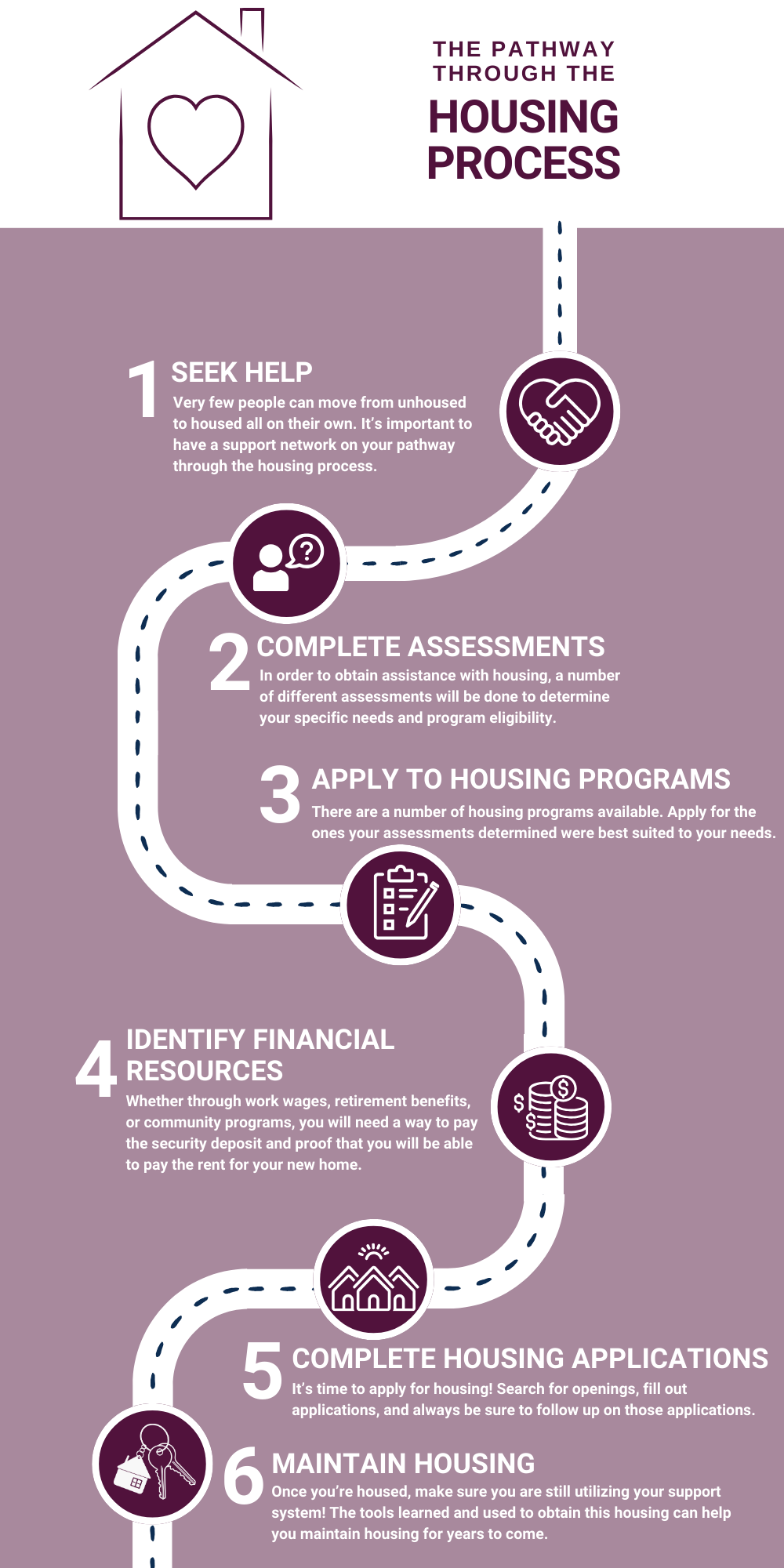
Step 1: Seek Help. Finding and maintaining housing can be extremely difficult alone. Luckily, there are organizations ready and willing to help! Qualified Housing Navigators and Case Managers can provide the support needed to progress towards housing goals. However, someone experiencing the effects of stress such as feeling overwhelmed, fatigue, and avoiding social interactions may find it difficult to locate and ask for help.
Step 2. Complete Assessments. Most housing assistance is tied to federal, state, or local assessments. These assessments can be long and ask sensitive questions. Someone experiencing stress effects such as depression, anxiety, lack of focus, or memory issues may find it difficult to fully and accurately complete all necessary assessments.
Step 3. Apply to Housing Programs. Between subsidized housing, project-based housing, and transitional housing, there are a lot of different program requirements and applications. Stress effects such as feeling overwhelmed, anxiety, fatigue, lack of motivation or focus, or memory issues may make it difficult to properly identify and apply to each available housing program.
Step 4. Identify Financial Resources. Prior to submitting any rental applications, establishing income, obtaining security deposit funds, and relevant credit reports and references is a must. Stress effects such as anxiety, depression, angry outbursts, frequent illness, fatigue, or avoidance of social interactions, may make it extremely difficult to identify and maintain financial resources.
Step 5. Complete Housing Applications. Searching for housing options that are affordable and will accept people with various challenges, applying, following up, and ultimately getting a housing placement is a daunting task. The stress effects of feeling overwhelmed, lack of focus or motivation, anxiety, depression, and fatigue can make it difficult for someone to properly find and apply for eligible housing options.
Step 6. Maintain Housing. Someone experiencing any stress effects including anxiety, depression, fatigue, or frequent illness may find it difficult to maintain their housing in the long term after all that work finding it.
At GFW, we are helping our guests on their pathway out of homelessness one step at a time, and we work hard to ensure these effects of stress are speed bumps, not roadblocks.
Creativity & Stress Relief
There are a number of methods one can use to reduce stress. Some common suggestions are meditation, exercise, connecting with friends and loved ones, laughing more, and yoga. Additionally, artistic activities that allow someone to exercise their creativity have been shown to not only decrease stress, but also build self-esteem while decreasing anxiety and depression. The best part? You do not have to have any prior artistic experience! Studies have shown that most people can gain the benefits of creativity and art therapy at any skill or experience level.
Of course, traditional Art Therapy has been studied extensively and has been effective at treating a lot more than stress. Art Therapy can significantly reduce trauma symptoms in adult trauma victims and veterans with PTSD, as well as building emotional resilience and emotional regulation in cancer patients, residents in nursing homes, and incarcerated individuals. One can infer from these results that art therapy is most effective in populations that have little control over their own situation or have limited options to change it, similar to those experiencing homelessness.
GFW’s Artistic Program Activities and Their Impact
In light of all these benefits, GFW has maintained a regular offering of program activities centered around arts & crafts while expanding those that directly have wellness benefits. To date, we offer:
- Art Workshops – including painting, jewelry making, fiber crafts, and more
- Art Journaling – a way for guests to keep a visual journal of their thoughts and emotions in lieu of a written one
- The Zen of Life – dedicated “adult coloring” time in a meditative environment proven to reduce anxiety
- Art as Healing – visual art workshop provided and supervised by the Arts Council for Monterey County
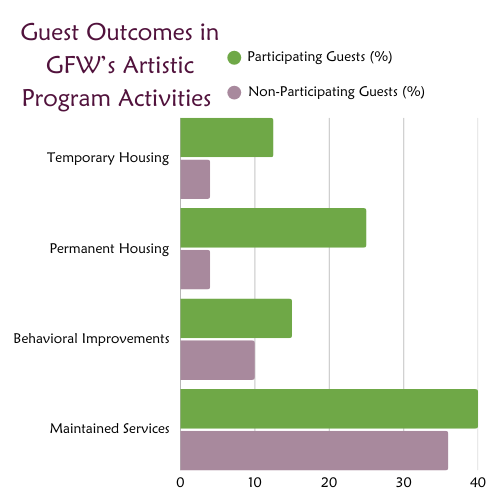
Forty guests have participated in GFW’s artistic program activities so far this year. Of those, 16 guests (40%) have maintained regular access to supportive services, two guests have moved into emergency housing programs or shelters, and four guests have found permanent housing already this year. Staff have also reported better emotional regulation, fewer behavioral incidents, and longer “periods of calm” between behavioral incidents for at least 6 (15%) program participants.
While most of this success must be credited to our amazing Next Step team, it is clear that guests who participate regularly in our artistic program activities have noticeably better outcomes than those that do not.
How can you help?
Looking for a creative outlet for your own stress? GFW encourages our volunteers to get involved or lead our program activities as often as they can! If you have a talent or hobby you would like to share with the GFW community, we would be delighted to include you. You can also check out our 6th Annual Art & Craft Fair taking place for the entire month of September. All proceeds from guest artworks go directly to the guest artist, and all proceeds from local, professional artists go to support GFW’s Day Center operations.
If you are a caring neighbor, an interested community member, or an art lover there are plenty of ways to support GFW and our guests. You can start by:
- Supporting local efforts to build more affordable housing
- Supporting local homelessness prevention efforts like rental assistance and financial education programs
- Volunteering your time and talents to local homeless service providers
- Donating clothing or personal care items, or making a monetary contribution to your local homeless service providers
- Becoming an ambassador by telling everyone you know about your favorite non-profit and what we are doing to help!
If you are ready to be part of the solution, you can find ways to get involved at GFW on our website, or contact us at info@gatheringforwomen.org.
The Main Contributor for this post is:
Resources used in this post:
- American Psychological Association – https://www.apa.org/topics/stress/health
- Center for Addiction and Mental Health – https://www.camh.ca/en/health-info/mental-illness-and-addiction-index/stress
- Stress and Health: Psychological, Behavioral, and Biological Determinants – https://pmc.ncbi.nlm.nih.gov/articles/PMC2568977/
- Mayo Clinic: Stress Symptoms – https://www.mayoclinic.org/healthy-lifestyle/stress-management/in-depth/stress-symptoms/art-20050987
- Mayo Clinic: Stress Relievers – https://www.mayoclinic.org/healthy-lifestyle/stress-management/in-depth/stress-relievers/art-20047257
- MentalHealthResearch.org – https://www.mqmentalhealth.org/the-art-of-destressing-how-creativity-creates-less-stress/
- Positive Effects of Art Therapy on Depression and Self-Esteem of Older Adults in Nursing Homes – https://www.tandfonline.com/doi/full/10.1080/00981389.2018.1564108
- Effectiveness of Art Therapy with Adult Clients in 2018 – What Progress Has Been Made? – https://www.frontiersin.org/journals/psychology/articles/10.3389/fpsyg.2018.01531/full
- Reduction of Cortisol Levels and Participants’ Responses Following Art Making – https://www.tandfonline.com/doi/full/10.1080/07421656.2016.1166832
- Can Coloring Mandalas Reduce Anxiety? – https://files.eric.ed.gov/fulltext/EJ688443.pdf
- Arts Council for Monterey County – https://arts4mc.org/