As we celebrate GFW’s 11th anniversary, we thought we would take some time to address a common myth surrounding our guests here at GFW. The women we serve every day are all unique and they all defy the most common stereotypes out there. Celebrate GFW’s anniversary with us by dispelling this persistent myth and seeing the truth behind each guest’s story.
Common Misconception: “A lot of people experiencing homelessness simply do not want housing or shelter.”
There is a persistent myth that people refuse housing assistance or shelter because they don’t want housing or shelter. There are plenty of anecdotes about someone who is experiencing homelessness saying that they prefer to live outside or that they make more money panhandling than they do working. While these stories exist, they are the exceptions, not the rule.
There are many reasons that a person may choose not to go into shelter or shared housing spaces. All of these reasons are valid and none of them mean that person doesn’t want housing or shelter. Let’s address some of the most common reasons for denying or delaying shelter and housing services.
Reason #1: Most shelters do not allow partners to stay together.
The vast majority of shelters are single-gender spaces. While this principle is integral to safety and is one of the principles GFW was founded on, there are still a number of people experiencing homelessness with their partners. Most shelters require men and women to be separated, regardless of marital or relationship status. In fact, one-tenth of homeless parents end up separated from partners when they seek shelter. A person who is experiencing homelessness already has fewer resources and a smaller support network than most, and asking them to purposely abandon an integral piece of that support network is very difficult. It can be even more complicated if only one partner is eligible for a shelter or housing program. Asking partners to sleep in separate buildings each night is already a difficult request; asking one person to sleep in a warm bed and leave their partner in a car or unsheltered is almost unthinkable.
In Monterey County, the only shelters that allow family units to shelter together are the Casa de Noche Buena (CDNB) shelter in Seaside, and the Shuman HeartHouse in Monterey. Even so, these shelters have a wait list that is consistently over 200 people, with family rooms taking as long as six months to open spots. Long waitlists with no guarantees that partners can stay together are huge hurdles for people experiencing homelessness as they are offered shelter or housing services.
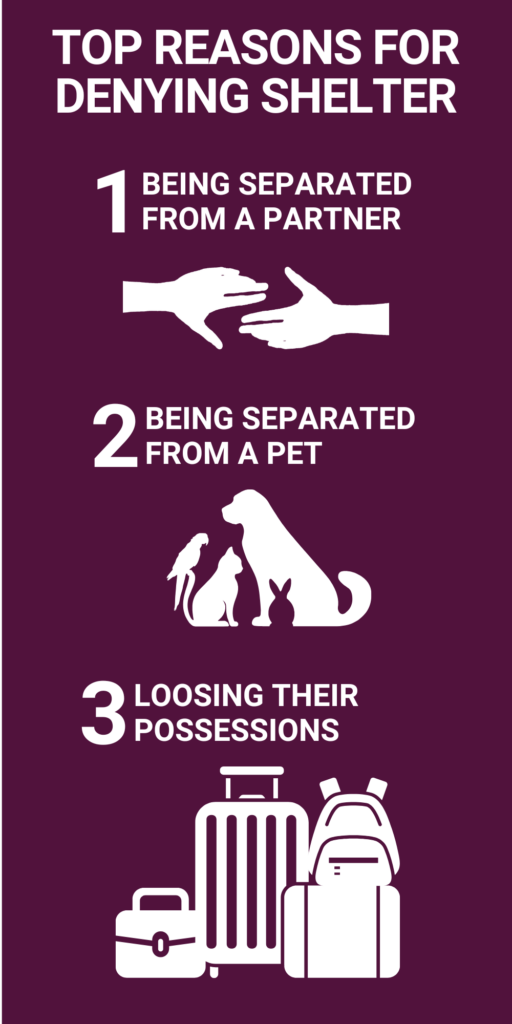
Reason #2: Most shelters do not allow pets.
While it makes sense that shelters responsible for multiple people’s safety and wellbeing may not be equipped to provide that same safety and care to animals, it is still difficult to ask someone with a pet to give up that pet for a mere chance at services. As stated by the National Alliance to End Homelessness, “Evidence shows that animal companionship is fortifying and contributes to the emotional well-being of people experiencing homelessness, including encouraging owners to obtain sobriety, leave abusive relationships, and avoid incarceration.” Single women especially tend to keep their pets after losing their housing, or acquire pets after becoming homeless for safety purposes. Often, staying in vehicles or unsheltered as a single woman can feel very unsafe, and having a pet that can wake you up at a sign of trouble or possibly intimidate any potential threats can be life-saving. Telling a person experiencing homelessness that they must give away their only companion and source of safety in order to sleep indoors is not very enticing without a guarantee of permanent supportive housing on the other side.
In Monterey County, the only shelter that allows pets is the SHARE Center in Salinas. This shelter is also the largest in Monterey County, so the amount of people who can enter this shelter is larger but the amount of people waiting is also large. With an average wait time of 6-12 months, the SHARE Center can be difficult to enter even for people without pets.
Reason #3: Most shelters have a limit on items a person can bring and store.
Many people experiencing homelessness do not have many possessions. However, what they do have is obviously
important to them, their survival, and their dignity. Emergency shelters that use a barracks-style set up offer no privacy or safekeeping of many belongings, often resorting to small lockers that can hold one bag of clothing and personal items at most. If a guest has more than one bag or suitcase, they can’t be guaranteed their items will be secured and they may not be allowed to bring those items in at all. Consider how many things one would have to sell, give away, or abandon just to downsize from a house to a car. Now consider how many more things would have to be lost to downsize again to only what can be carried. What few items are left are extremely valuable and necessary for each person’s wellbeing. When the price for one night in shelter is to lose all or most of your remaining personal possessions, it’s no wonder many guests do not elect to utilize those services.
On the Peninsula, the only shelter program that offers same-day shelter is I-HELP. However, due to transportation restrictions, guests are limited to two bags or suitcases. Guests with more items than this are often faced with a choice to go unsheltered or to throw away what few belongings they have in order to make it onto the bus that day. Repeatedly forced with this choice, with no guarantee of housing on the other side of it, it is easy to see why some would chose not to go into shelter systems.
Reason #4: Previous or repeated negative experiences discourage people from accepting services.
A person who has accepted services in the past, perhaps at the expense of their partner, their pets, or their possessions, who was then not placed in permanent housing will likely not trust future service offerings. Sometimes it takes multiple rounds of services or shelter before a person finds permanent supportive housing. With the maximum stays at emergency shelters being only 90 days, people receiving shelter services are under tremendous pressure to achieve their goals in a very short time frame.
At GFW, our guests spend an average of three years using our services before permanent housing can be secured due to multiple factors like lack of affordable housing and underfunded programs throughout the county. That’s a maximum of 12 stays in a short-term emergency shelter like Casa de Noche Buena or Shuman HeartHouse. After the first two times a person has to give up someone or something important to them only to be exited back onto the street in three months’ time, it is highly unlikely they will continue to accept services from the same providers. With each repeated entry to programs – without then exiting to permanent housing – a person is less likely to trust those service programs and thus less likely to accept services in the future.
Reason #5: People experiencing homelessness may not wish to be housed with others going through similar situations.
At GFW, we know that everyone is on their personal pathway out of homelessness and that not all pathways look the same. Sometimes, guests who are further along that pathway do not wish to be housed or sheltered with guests just starting on their journeys. Some people experiencing homelessness will deny or delay housing services if the housing programs offered to them are in areas with known substance use or criminal activity – even if they have or had struggled with substance use themselves. These guests often cite their own sobriety and recovery as their main priority, meaning they are willing to go unsheltered in order to avoid a living situation near constant temptation.
This type of objection is one of the more difficult kinds to address as it directly interferes with the proven Housing First model, which provides shelter for anyone who asks, regardless of substance use or mental illness. Solutions to this include rental assistance programs, which encourages housing assistance in any location, not just program-specific housing. While local housing assistance programs like Interim, Inc. and Community Homeless Solutions provide permanent and transitional housing programs, many of them are a Housing First model in specific locations. So, for those people who elect to remain unsheltered in order to maintain distance from others currently struggling with substance abuse or those in recovery, general rental assistance programs are a way to provide housing assistance in any location the participants feel comfortable. Given there are so few rental assistance programs in Monterey County (at the time of this publication, the City of Monterey has one of the only successfully implemented programs) and they are difficult to budget for due to the inconsistent nature of housing costs, it is highly unlikely everyone who wants housing will be able to participate in this type of program. This leaves people who would otherwise be willing to accept services delaying services or denying services altogether in an effort to protect their own health and wellbeing.
Conclusion: People experiencing homelessness can sometimes be reported as “denying services” if they cannot participate in a housing assistance or shelter program at a specific time. This does not mean they never want housing.
People are more likely to deny or delay entering shelter programs if those programs do not allow their pets, partners, or possessions. They are also likely to deny or delay entering programs that are “short-term” solutions, like shelters, if they believe there is no available and affordable housing afterwards. It does not make sense to give up their support networks, beloved pets, or vital possessions for three months, only to end up back where they started with no way of reconnecting to their loved ones, re-adopting their pets, or re-acquiring their possessions. As Shaunn Cartwright, a member of the rapid encampment support team in San Jose, CA puts it, “A lot of people want to go inside, but they also want to be met halfway.”
“When their needs are met and their needs are considered, then people will come indoors.” – Nichole Fiore, ABT Global
According to the final evaluation of Project Roomkey released in May of 2024, the innovative approach to sheltering the unhoused – giving each person a private room and bathroom with lockable doors to store their belongings and space for partners and pets – finally dispelled this persistent rumor that people experiencing homelessness did not want to live indoors. In fact, people who had never accepted beds in traditional shelters were willing to try Roomkey specifically because of the privacy and autonomy it afforded. “People will come indoors if they are offered autonomy, safety, privacy, if they’re able to keep their partners, their pets, their possessions, ” said Nichole Fiore a Principal Associate with research firm ABT Global who co-authored the final evaluation report for Project Roomkey. “When their needs are met and their needs are considered, then people will come indoors.”
How Can You Help?
As we experience the “rainy season” on the Peninsula, you may have more opportunities to talk about these limitations in shelter models with your friends and family members. It’s always helpful to have more information, so feel free to share this blog with your loved ones, and contact GFW if you have any questions or want additional information. You can also support GFW and our guests by:
- Supporting local efforts to build more affordable housing
- Supporting local homelessness prevention efforts like rental assistance and financial education programs
- Volunteering your time and talents to local homeless service providers
- Donating clothing or personal care items, or making a monetary contribution to your local homeless service providers
- Becoming an ambassador by telling everyone you know about your favorite non-profit and what we are doing to help!
If you are ready to be part of the solution, you can find ways to get involved at GFW on our website, or contact us at info@gatheringforwomen.org.
The Main Contributor for this post is:
Resources used in this post:
- California Health Report – https://www.calhealthreport.org/2018/05/09/many-homeless-families-tough-choice-separation-shelter-bed/
- Casa de Noche Buena – https://chservices.org/homelessness/casa-de-noche-buena/
- Shuman HeartHouse – https://chservices.org/homelessness/main-shuman-hearthouse/
- EndHomelessness.Org – https://endhomelessness.org/resources/toolkits-and-training-materials/pets/
- Community Housing Network – https://communityhousingnetwork.org/the-human-animal-bond-a-lifeline-for-people-experiencing-homelessness/
- The SHARE Center – https://chservices.org/homelessness/sharecenter/
- I-HELP – https://www.ihelpmontereybay.org/
- Data Share Monterey County – https://www.datasharemontereycounty.org/indicators/index/dashboard?alias=Housing
- Wilson, Roxanne. “Monterey County Homelessness Funding Extensions Chinatown Navigation & SHARE Centers in Salinas, CA.” – https://www.youtube.com/watch?v=4KdvNq-1LME
- Interim, Inc. – https://www.interiminc.org/
- Community Homeless Solutions – https://www.communityhomelesssolutions.org/
- City of Monterey Rental Assistance Program – https://monterey.gov/your_city_hall/departments/community_development/housing_programs/rental_assistance_program.php
- Cal Matters. “7 Myths about Homelessness in California.” – https://calmatters.org/housing/homelessness/2024/07/california-homelessness-myths/
- ABT Global. “Project Roomkey Evaluation Final Report.” – https://www.abtglobal.com/insights/publications/report/evaluation-california-project-roomkey-program-year-1-report
- Cal Matters. “Did California’s Massive COVID Homeless Shelter Program Work? A New Evaluation Probes the Results.” – https://calmatters.org/housing/homelessness/2024/05/california-homeless-project-roomkey/