Happy New Year! A new year means new challenges, new opportunities, and new numbers. At the end of January 2026, the biennial Homeless Census or “Point-in-Time Count” will be performed, so let’s take a look at what it is, why it’s so important, and why we’ll be talking about it for years to come.
What is the Continuum of Care?
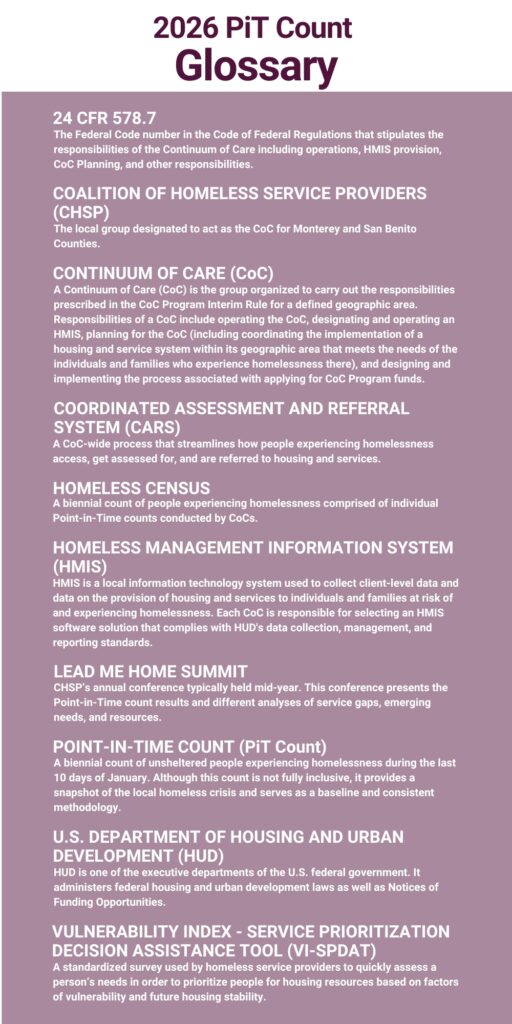
The Continuum of Care (CoC) is a group organized along city or county lines that carries out the federally mandated responsibilities of a CoC for that area. Gathering for Women – Monterey (GFW) is in CA-506 which includes both Monterey and San Benito Counties. Our local CoC is the Coalition of Homeless Service Providers, whom we work with regularly.
The CoC is responsible for all local competitions for Federal funding, establishing and operating the Homeless Management Information System database, establishing and operating the local Coordinated Assessment and Referral System, and operating the Vulnerability Index – Service Prioritization Decision Assistance Tool assessment and database. In essence, the Coalition of Homeless Service Providers is a one-stop shop for GFW and our community partners for any federal funding or tech-related questions.
What is the Point-in-Time Count?
The Point-in-Time Count (the PiT) is the local count of all people experiencing homelessness within our CoC – Monterey and San Benito Counties. This is the main data point used for all the data and statistics you see about homelessness at the local level, and it provides the backbone for all data-driven decision making in federal, state, and local government with regards to homeless services and funding. The PiT count focuses on those that would be considered “Literally Homeless” or “Category 1” of the HUD definitions of homelessness. As we detailed in our very first blog post, this category is what most people think of when they think of homelessness: an individual or family who lacks a fixed, regular, and adequate nighttime residence. This is anyone who lives unsheltered or whose only residence is an emergency shelter.
Each CoC is required to complete their PiT Counts within the last 10 days of January. Then, all PiT Counts for all CoCs are
compiled together to complete the Homeless Census – the nationwide data on people experiencing homelessness across the U.S. After the data is collected, analyzed, and compiled into the Homeless Census, the results are released to the public to better inform decision making going forward. The Coalition of Homeless Service Providers typically presents these findings at their annual Lead Me Home summit.
What is the Homeless Census?
Every two years, the U.S. Department of Housing and Urban Development (HUD) requires each Continuum of Care (CoC) to complete a Point-in-Time (PiT) Count in accordance with 24 CFR 578.7. These individual counts are compiled to provide a broad overview of the state of homelessness in the U.S. It’s important to note that the Homeless Census is conducted every two years, but the CoC also conducts an Annual Gap Analysis each year to assess the needs and services available within the area.
The Homeless Census is very important to all homeless service providers – GFW included. In addition to assessing the scope of homelessness, tracking progress on housing goals, identifying new and growing needs, and meeting the federal reporting requirements from HUD, the results of the Homeless Census are used to allocate federal funding and deeply affect local planning for homeless services. The results of the Homeless Census can affect all services from the supportive, wrap-around services GFW provides to the permanent housing assistance the Housing Authority of Monterey County provides.
How is the PiT Count Conducted?
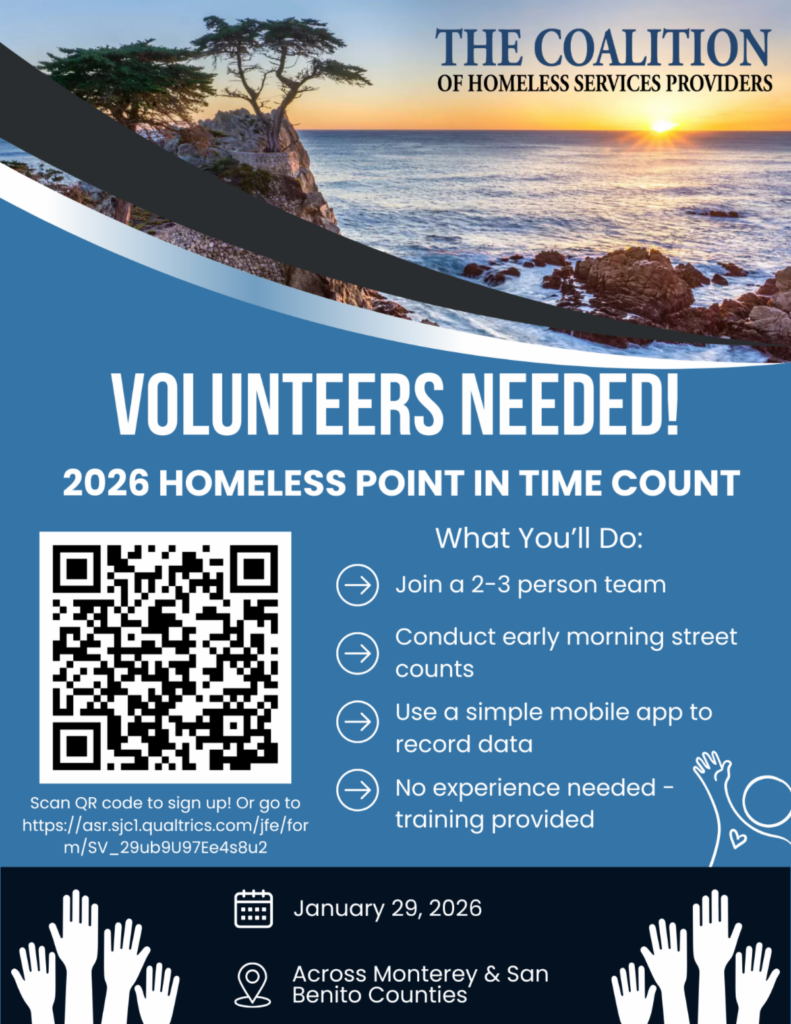
The PiT Count is conducted by volunteers! You can volunteer either in groups or as individuals (who will be assigned groups). These groups are then given a small area to cover, in which they will survey and literally count the number of individuals exposed to the elements, in tents, or in vehicles. The PiT Count is typically conducted in the early morning hours in an effort to provide unduplicated counts as people are more likely to be sleeping or just waking up during these times and not actively moving between survey areas.
In addition to the literal count, there are a number of interviews and focus groups conducted by community partners in order to learn more information on the nature of homelessness, the primary causes of homelessness, and the current barriers to permanent housing. These interviews and focus groups provide invaluable data to homeless service providers like GFW so we can prepare for and meet any new or changing elements of homelessness for our guests.
If you or someone you know would like to volunteer for the PiT Count, you can contact the Coalition of Homeless Service Providers or scan the QR code provided here. You can sign up with friends, family, coworkers, or join as an individual to be placed in a team with others. The more volunteers, the better!
Current Challenges with the PiT Count
While the PiT Count is absolutely our best source of information on homelessness on both the state and local levels, it does come with its challenges. Crucially, the timing of the PiT Count, while certainly advantageous to some cities and counties, is not ideal for California. Places like New York and Chicago are generally able to count the number of shelter beds in use on any given night because freezing temperatures and abundant shelter beds mean that the vast majority of their homeless populations can be quickly and easily counted in shelters. However, in California and especially in Monterey County, late January means rain – not snow. The rain typically makes it harder to get the most accurate count possible due to more people taking shelter in undisclosed or not-visible areas, and more tents that can hold an unknown number of people to keep them dry. Additionally, Monterey County has fewer available shelter beds per capita than recommended, meaning even with the numbers from shelters, it is still vital we accurately count the unsheltered individuals to get any representative numbers. For these reasons, it’s safe to assume that Monterey County, like most coastal counties in California, is likely under-counting the actual number of people experiencing homelessness on any given night.
Current Opportunities with the PiT Count
Despite any challenges or imperfections, the PiT Count is still a homeless service provider’s lifeline. It is thanks to the 2024 PiT Count that we know financial challenges, rising rents, low income, and the ongoing affordability crisis are the main factors leading to homelessness and the same obstacles preventing our guests from obtaining permanent housing. The PiT count also lets us know that the vast majority of Monterey County’s homeless population – 81% in fact – are from Monterey County, fully overturning the persistent narrative that they are travelers from other counties or out of state. And, comparing the age demographics of the 2024 PiT Count to the previous ones shows us that people 50 and older are the fastest growing demographic of those experiencing homelessness – a fact GFW has been seeing for some time and now has the county-wide data to support.
GFW is excited to see what new insights the 2026 PiT Count can bring us, and we look forward to the new, innovative ways we can work together with our community partners in order to best serve our guests’ new and emerging needs.
How Can You Help?
If you are interested in the Monterey County Point-in-Time (PiT) Count, you can volunteer by scanning the QR code above or reaching out directly to the Coalition of Homeless Service Providers at info@chsp.org. And, don’t forget to keep an eye out for this year’s Lead Me Home summit for the report on the findings!
If you are interested in local homeless service providers and how we are using the PiT Count data to better serve our neighbors experiencing homelessness, you can reach out to GFW and our community partners for more information. You can also support GFW by:
- Supporting local efforts to build more affordable housing
- Supporting local homelessness prevention efforts like rental assistance and financial education programs
- Volunteering your time and talents to local homeless service providers
- Donating clothing or personal care items, or making a monetary contribution to your local homeless service providers
- Becoming an ambassador by telling everyone you know about your favorite non-profit and what we are doing to help!
If you are ready to be part of the solution, you can find ways to get involved at GFW on our website, or contact us at info@gatheringforwomen.org.
The Main Contributor for this post is:
Resources used in this post:
- Code of Federal Regulations – https://www.ecfr.gov/current/title-24/subtitle-B/chapter-V/subchapter-C/part-578/subpart-B/section-578.7
- Coalition of Homeless Service Providers – https://chsp.org/
- HUD Exchange, HMIS – https://www.hudexchange.info/programs/hmis/
- CHSP, CARS – https://chsp.org/coordinated-entry/
- Community Homeless Solutions, VI-SPDAT – https://www.communityhomelesssolutions.org/apply-for-housing
- County of Monterey Homeless Data – https://www.countyofmonterey.gov/government/departments-a-h/administrative-office/homelessness-strategies-and-initiatives/homelessness-data
- CHSP, Point-in-Time Count – https://chsp.org/continuum-of-care/coc-activities/census/
- GFW, Definitions of Homelessness – https://gatheringforwomen.org/what-is-homelessness/
- CHSP, Lead Me Home – https://chsp.org/continuum-of-care/coc-activities/lead-me-home-plan/
- 2024 Point-in-Time Count – https://chsp.org/wp-content/uploads/2025/03/2024-Monterey-County-Census-Release-Presentation.pdf
- CBS News, “America’s deepening affordability crisis summed up in 5 charts.” – https://www.cbsnews.com/news/affordability-2025-inflation-food-prices-housing-child-care-health-costs/