Whether you’ve been working in homeless services for years or are new to the realities faced by this community, you’ve likely got a lot of questions about the information you’re finding. Why does every service provider have a different number of homeless individuals? Why are the numbers so different from each other? How can the Coalition of Homeless Service Providers say there are 2,500 individuals experiencing homelessness, but the school says over 12,000 children are homeless? None of it makes sense!
Homelessness is a complex issue, and its definition can vary depending on the context. In the late 90s, a pair of researchers studying homelessness in New York City and Philadelphia coined the “Four Types” of homelessness used colloquially today. These definitions are based on the amount of time an individual or family spends unsheltered, and are the easiest to conceptualize for people who may not spend a lot of time in working in homeless services.
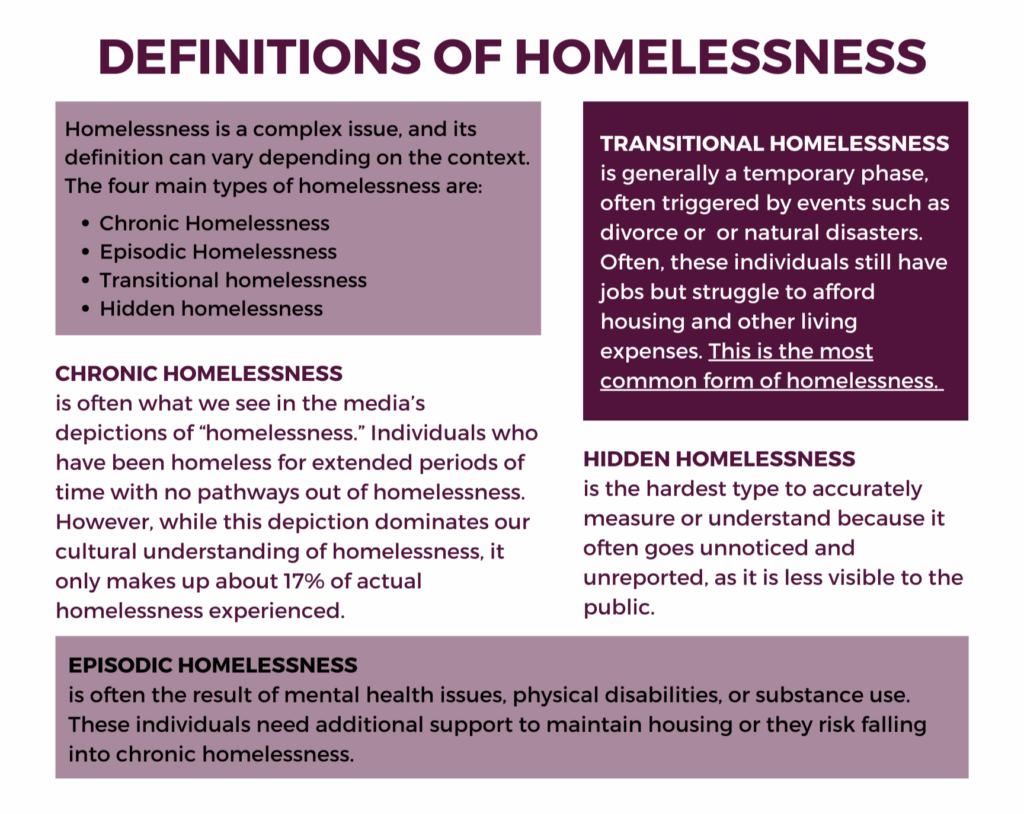
The four main types of homelessness are often referred to as Chronic, Episodic, Transitional, and Hidden.
-
- Chronic homelessness refers to individuals who have been homeless for extended periods (often a year or more) or those who experience repeated episodes of homelessness. These individuals often struggle with disabling conditions such as physical disabilities, mental illness, or substance use disorders. When we see “homelessness” depicted in media, it is often chronic homelessness, which can lead to the false impression that all individuals experiencing homelessness are chronically homeless. However, according to the National Alliance to End Homelessness, people experiencing chronic homelessness only make up about 17% of the homeless population. They typically live in places not meant for human habitation, such as streets, cars, or parks.
- Episodic homelessness involves individuals who cycle between periods of being housed and unhoused, usually experiencing at least three separate instances of homelessness within a year. Many of these individuals are younger and may be dealing with health issues or addiction. Differing slightly from those experiencing chronic homelessness, these individuals have some support systems in place to obtain housing but need additional support to maintain their housing once they do. Assistance is critical at this stage because episodic homelessness can quickly develop into chronic homelessness if not addressed.
- Transitional homelessness – or “situational homelessness” as it is sometimes known – is generally a temporary phase, often triggered by events such as job loss, eviction, aging out of foster care, or natural disasters. Individuals facing this type of homelessness need support to transition into stable housing. Often, they still have jobs but struggle to afford housing and other living expenses. This is the most common form of homelessness.
- Hidden homelessness refers to individuals and families who lack stable, permanent housing but are not living on the streets or in shelters. Instead, they may be staying in motels, cars, RVs, or temporarily with others. This form of homelessness often goes unnoticed and unreported, as it is less visible to the public. Women experiencing homelessness, in particular, are more likely to be in this group as it makes them less of a target for harassment. These individuals face uncertainty about their housing situation, with no guarantee of long-term accommodation and no immediate way to secure permanent housing.
It should be noted that in 2009, the HEARTH Act was passed, which expanded the definitions to include those who were at imminent risk of losing their housing, fleeing domestic violence, or considered homeless under “other federal statutes” which can include the McKinney Vento Act definition of homelessness (explained below). HUD uses these updated inclusions, but these four “types” of homelessness are still the primary categories for those considered “literally homeless” in the HUD definition.
Who is using these definitions?
The U.S Department of Housing and Urban Development (HUD) is the federal Agency that oversees national policy and programs related to housing needs and fair housing laws. HUD defines homelessness as individuals or families who lack a fixed, regular, and adequate nighttime residence. According to HUD, homeless people can be found in places like shelters, on the streets, or in other locations not meant for human habitation. The HUD definition is more focused on the immediate lack of housing and conditions that directly impact people’s ability to maintain permanent housing. The annual Monterey County Point-in-Time Count conducted by the Coalition of Homeless Service Providers and most non-profit organizations, including GFW, use the HUD definitions when describing the population we serve.
The McKinney-Vento Homeless Assistance Act is a federal law that provides important educational rights and services to Pre-K and K-12 children and youth experiencing homelessness. It primarily addresses the needs of homeless children and youth in schools and defines homelessness more broadly. The Act includes not only individuals living in shelters or on the streets but also those who are temporarily living with others due to a lack of housing (often referred to as “doubling up”). McKinney-Vento also recognizes that homelessness encompasses individuals living in motels, cars, or other temporary housing arrangements. The law focuses on ensuring that homeless children and youth have access to public education; therefore, school districts are the main organizations using the McKinney-Vento definition. Because the McKinney-Vento definition includes families and children “doubling up” with others, it usually means the numbers of those considered homeless according to McKinney-Vento are significantly higher than the numbers HUD uses.
For comparison, the Monterey County Point-in-Time Count using the HUD definitions found there to be 225 homeless children and youth in Monterey County in 2024, while the Monterey County Office of Education found that 12,959 children enrolled in schools qualified as homeless at some point in the 2023-24 school year under the McKinney-Vento definition. It’s understandable to be confused by this huge discrepancy if you didn’t know these two organizations were using different definitions of homelessness!
How can you help?
These distinctions can be very helpful to those interested in solving homelessness, but for our community members who are experiencing homelessness, they are just more words on a page. No matter what category our guests fall into under any definition, they all need the services provided at Gathering for Women. You can support GFW and our guests by:
-
- Supporting local efforts to build more affordable housing
- Supporting local homelessness prevention efforts like rental assistance and financial education programs
- Volunteering your time and talents to local homeless service providers
- Donating clothing or personal care items, or make a monetary contribution to your local homeless service providers
- Becoming an ambassador! Tell everyone you know about your favorite non-profit and what we are doing to help!
If you are ready to be part of the solution, you can find ways to get involved at GFW on our website, or contact us at info@gatheringforwomen.org.
The Main Contributor for this post is:
Resources used in this post:
-
- CaringWorks, Inc. – https://www.caringworksinc.org/did-you-know-there-are-four-types-of-homelessness/
- Comic Relief – https://www.comicrelief.org/posts/what-are-the-four-types-of-homelessness
- Better Angels, LA: https://www.betterangels.la/halo/services/what-are-the-four-types-of-homelessness
- School House Connection – https://schoolhouseconnection.org/article/mckinney-vento-act-quick-reference
- National Alliance to End Homelessness – https://endhomelessness.org/
- National Library of Medicine: https://www.ncbi.nlm.nih.gov/books/NBK519584/
- HUD Exchange: https://www.hudexchange.info/homelessness-assistance/coc-esg-virtual-binders/coc-esg-homeless-eligibility/four-categories/
- Alternative Family Services – https://www.afs4kids.org/
- The 2024 Monterey County Homeless Census – https://chsp.org/wp-content/uploads/2025/03/2024-Monterey-County-Census-Release-Presentation.pdf
- Monterey County Office of Education – https://www.montereycoe.org/divisions-services/student-services/homeless