Tell Me More! This series is meant to provide detailed information and resources on topics that need a lot of explaining. In the first of our Tell Me More series, we explore some of the common talking points around homelessness, separate the facts from fiction, and provide resources for those who want to dive deeper.
We start this series with one of the most pervasive myths about people experiencing homelessness. We hope this post provides some much needed clarity on the subjects of substance use disorder (SUD) and addiction. If you or someone you love is struggling with a substance use disorder or addiction, you can call the National Helpline (USA) at 1-800-622-HELP (4357), or our local information desk at 211.
Fiction: “All homeless people are drug addicts!”
There is a common and persistent myth that all people experiencing homelessness became homeless because of an addiction. This generalization leads some people to the misinformed assumption that they “chose” to be homeless because they “chose” their addiction over their housing.
Fact: The vast majority of people experiencing homelessness do not have a substance use disorder.
According to many years worth of census data, the national, state, and even Monterey County average of homeless individuals who also have a substance use disorder hovers around 40%. While this is certainly higher than the percentage of housed individuals struggling with addiction, it is by no means “all” – or even half! There are even studies that suggest that, of the 40% who are struggling, half of them only started using substances (or increased their use to the level of addiction) after they became homeless, as a coping mechanism.
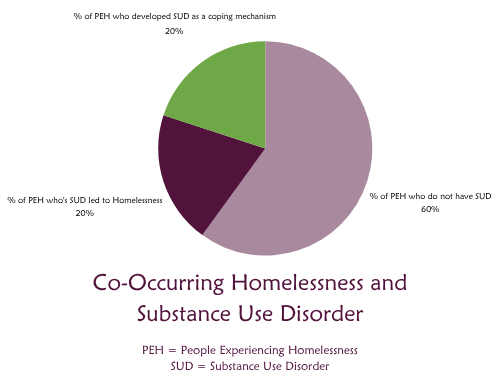
Suppose we exclude the 60% of people experiencing homelessness who do not have a substance use disorder at all, and the 20% who only developed a substance use disorder after becoming homeless; this leaves us with only 20% of people experiencing homelessness where a substance use disorder was the primary cause of their homelessness. This rate is much closer to the addiction rate in housed individuals, which is 16.7%.
“As I was driving on Fremont, I saw a man come out of a liquor store carrying two huge bottles of Fireball. Because he got into a Bentley, my assumption was “Oh, he must be having a party.” But, when someone who is visibly homeless walks out of a liquor store carrying two large bottles of liquor, no one ever assumes that. There is a huge disparity in how this action is perceived because of these really prevalent stereotypes.” – GFW Staff
Fiction: “They’ve made their choice!”
This fallacy is quite pervasive for all people who have struggled with substance use or addiction, not just people experiencing homelessness. This idea stems from people without a substance use disorder who can’t understand why someone else can’t choose to stop. Addiction is not a choice.
Fact: Substance Use Disorder (SUD) is a disease, just like any other.
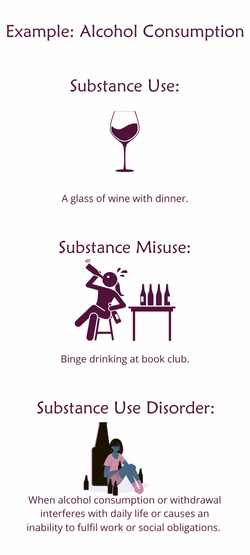
It’s been understood in the medical and psychiatric community for a long time that substance use disorder is a disease. Risk factors for this disease include genetics, environmental factors, stress, and other mental health disorders. While it’s easy to understand that no one chooses to get the flu, it can be harder to understand that no one chooses a substance use disorder – especially given that there are many levels of substance use that are entirely acceptable, as seen in the image to the right. A person can have completely acceptable levels of substance use and even some level of substance misuse without it being considered a substance use disorder or addiction.
Our neighbors experiencing homelessness have higher levels of stress, a higher likelihood of trauma and untreated mental illness, and more co-occurring physical health conditions compared to our housed neighbors, and significantly fewer resources with which to obtain support. In fact, “self-medication” was listed as a primary reason for substance use by over two-thirds of those surveyed by American Addiction Centers. If we understand that addiction is a disease, we can understand that no one is “choosing” to have a substance use disorder or “choosing” that addiction over housing.
“A few years ago, I was at the front desk and a guest came in just falling to pieces. She was a crying, nervous wreck. She had just been given a DUI the night before and was afraid it meant she would lose her housing voucher and her chance at finding a home. Through tears she told me that she had been celebrating finding housing through her voucher with a glass of red wine at dinner – but because her car was her kitchen and her armrest was her table, she received a DUI. We never question when someone has a glass of wine with dinner in the privacy of their own home, but someone who is homeless lives so publicly that all they get are questions. It must be exhausting.” -GFW Staff
Fiction: “My taxes are being wasted on drug addicts!”
Because the cost of substance use treatment, recovery, and rehabilitation is so high, many people who do not struggle with this issue see all community spending in this area as a direct expense to their community programs paid for with their own tax dollars. While the money spent on these community-funded treatment options is primarily sourced from state and local taxes, it’s actually a way for local governments to save money.
Fact: Funds spent on SUD treatment save more money for taxpayers than other necessary community programs.
Finding a treatment center that is both local and affordable for people experiencing homelessness is no small task. While
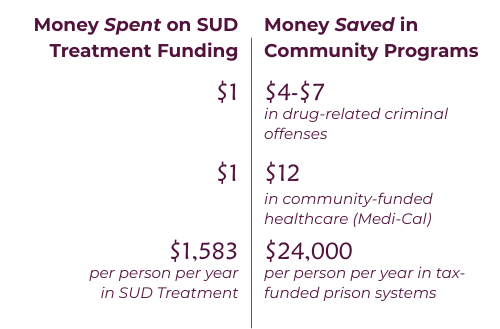
there are some incredible programs offered in Monterey County, the need is higher than the available beds in these treatment centers, leading to multiple people ready to make a change who are still unable to access the resources needed to do so. Luckily, there are some options available using sliding-scale rates, and some treatment centers that can accept Medi-Cal to cover the costs. Programs like these are necessary to help all of those struggling in our community with substance use – not just our neighbors experiencing homelessness. And, believe it or not, it is extremely cost-effective for communities.
Seeking Treatment
Of course, with 40% of people experiencing homelessness also having some level of substance use disorder, it is an issue GFW sees a lot. Some of the most common barriers to treatment are a lack of local resources and a loss of support networks. After a person loses their housing, they begin a terrible journey of social isolation that rips away their support networks, making it even harder to obtain housing or seek treatment for substance use. As reflected in a common sentiment shared by noted author, Kevin F. Adler, at Casa de Noche Buena’s Anniversary Event: “I never realized I was homeless when I lost my housing. Only when I lost my family and friends that provided me with support.” At GFW, we seek to provide that caring community for all of our guests; and naturally, some of our guests who are ready to seek treatment for substance use will lean on us as staff, volunteers, and our broader community as their support network. Having access to social support networks increases treatment retention and strengthens mental resolve towards abstinence. It’s also been linked to greater quality of life, lower stress, and lower relapse rates.
If you or someone you love is struggling with substance use or addiction, there are support networks available to help. Some options in Monterey County are:
- Monterey County Behavioral Health ACCESS line: 1-888-258-6029
- Community Human Services: 831-237-7222
- Door to Hope: 831-758-0181
- SunStreet Centers: 831-753-6001
- Valley Health Associates: 831-424-6655
- United Way’s 211 Resource Center: 211
National Resources (USA):
- Substance Abuse and Mental Health Services Administration (SAMHSA): 1-800-622-HELP (4357)
- American Addiction Centers: 1-866-745-9060
- National Association of Free & Charitable Clinics: 703-647-7427
How can you help?
If you are interested in more information on the intersections between homelessness and substance use, we encourage you to follow the links in the Resources Used section. If you are interested in supporting GFW’s work, you can do so by:
- Supporting local efforts to build more affordable housing
- Supporting local homelessness prevention efforts like rental assistance and financial education programs
- Volunteering your time and talents to local homeless service providers
- Donating clothing or personal care items, or making a monetary contribution to your local homeless service providers
- Becoming an ambassador and telling everyone you know about your favorite non-profit and what we are doing to help!
If you are ready to be part of the solution, you can find ways to get involved at GFW on our website, or contact us at info@gatheringforwomen.org.
The Main Contributor for this post is:
Resources used in this post:
- Substance Abuse and Mental Health Services Administration (SAMHSA): https://www.samhsa.gov/find-help/helplines/national-helpline
- 211 Monterey County: https://211montereycounty.org/
- American Addiction Centers, “Substance Abuse and Homelessness: Statistics and Rehab Treatment”: https://americanaddictioncenters.org/rehab-guide/addiction-statistics-demographics/homeless
- University of California San Francisco: https://www.ucsf.edu/news/2025/02/429486/how-common-illegal-drug-use-among-people-who-are-homeless
- 2024 Monterey County Homeless Census: https://chsp.org/wp-content/uploads/2025/03/2024-Monterey-County-Census-Release-Presentation.pdf
- National Coalition for the Homeless: https://nationalhomeless.org/wp-content/uploads/2017/06/Substance-Abuse-and-Homelessness.pdf
- American Addiction Centers, “Alcohol and Drug Abuse Statistics”: https://americanaddictioncenters.org/rehab-guide/addiction-statistics-demographics
- American Addiction Centers, “The Cost of Going to Rehab: How Much Does Rehab Cost?”: https://americanaddictioncenters.org/rehab-guide/rehab-cost
- National Library of Medicine, “The Importance of Social Support in Recovery Populations: Toward a Multilevel Understanding”: https://pmc.ncbi.nlm.nih.gov/articles/PMC10259869/