The term “Silver Tsunami” is a metaphor for the increasing number of older adults reaching retirement age. First used in the 2010s, it usually refers to the potential challenges that could be faced by employers, healthcare providers, and the housing markets as record numbers of people begin retiring, needing increasingly complex healthcare, and downsizing their homes. It is now, unfortunately, also an apt metaphor for the changing landscape of those experiencing homelessness.
What is happening?
The number of homeless seniors is growing at an alarming rate, and is expected to triple by 2030. These individuals are more likely to rely on fixed incomes, pushing them into homelessness faster when the cost of living increases, a medical emergency occurs, or an unforeseen life event happens. Currently, unaccompanied adults aged 50 and older make up 40% of California’s homeless population, despite being only 34% of California’s total population. Even more concerning: of these same older adults, 41% are experiencing homelessness for the first time after 50.
How did this happen?
At GFW, we know everyone’s story is different; no one loses their housing in the same way. However, some common factors can lead to homelessness such as loss of income, severe medical events, or substance use.
For older adults, these factors look very different. In the 2022/23 fiscal year, 72% of older adults experiencing homelessness had a disabling condition, which can severely impact their ability to work or maintain independent housing. These medical conditions, coupled with rising housing costs, are the biggest factors that lead to homelessness for older adults.
California, in particular, has one of the largest percentage of renters who are spending over 50% of their household income on housing. This demographic is considered “severely cost burdened” when discussing cost of living gaps. Even those who own their homes and have paid off their mortgages may find it difficult to keep up with rising property taxes, repairs, insurance rate increases, HOA fees, or utility costs on a fixed income. Because older adults are more likely to be severely cost burdened or unable to afford property taxes and upkeep on their fixed income already, any unexpected expenses can be enough to push someone from housed to homeless.
Don’t they have public benefits to support them?
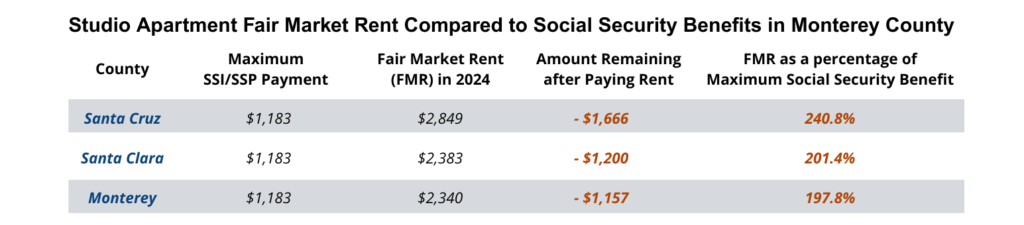
Yes and no. The majority of older adults facing homelessness do have Social Security: Supplemental Security Income aka SSI (median = $1,037) or Social Security Disability Insurance aka SSDI (median = $1,040). However, these benefit amounts are insufficient to meet rising housing costs in California, and especially in Monterey County. In 2024, the Fair Market Rate in Monterey County for a studio apartment was $2,340 – nearly double the maximum amount local seniors can receive from their Social Security Benefits and the third highest rate in all of California behind Santa Cruz and Santa Clara counties.
Additionally, the majority of existing state and federal aid available for rental assistance is targeted at families with children, and most of the proposed revisions to these public benefits suggest work requirements that retired or disabled seniors will struggle to meet. This leaves disabled, retired, and low-income seniors without any additional supports or benefits to help prevent their homelessness.
Why is this important right now?
As the baby boomer generation (those born between 1946 and 1964) ages, the impact of their retirement and aging processes will be larger simply because their generation is larger. By 2030, 30.4 million Americans will turn 65, but only one-third of them will be financially prepared for retirement. This leaves nearly 20 million older Americans at risk of homelessness in the next 5 years, and our communities are not prepared.
For example, we’ve known for a while that this aging population will strain our healthcare system. However, research has shown that homelessness takes a significant toll on the body, and individuals who experience it in their 50s and 60s may exhibit signs of accelerated aging, such as cognitive decline, difficulty walking, and often premature death. This means someone experiencing homelessness at age 50 has the health concerns equivalent to a housed person in their 70s or 80s, adding additional strain to an already burdened healthcare system.
Homeless service providers are working hard to shift their service models to accommodate the needs of a rising senior population. A 2023 report from the U.S. Department of Health & Human Services highlighted an increased need for homelessness prevention strategies that has since been incorporated into multiple state and federal budgets. Service providers who previously only focused on sheltering unhoused individuals have started outreach to housed, low-income individuals in an effort to increase homelessness prevention. On average, homeless prevention programs cost 49.5% less than other housing programs; it is far easier to keep someone in their housing than it is to find a housing placement for someone who has lost theirs.
These stop-gap measures are helping, but they won’t be enough to stop the rising tide.
How can you help?
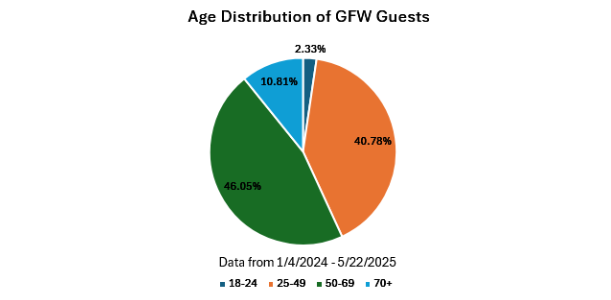
Responding to the needs of the “Silver Tsunami” might seem daunting just from the sheer scale of it, but if everyone does something small, we can accomplish big things together! At GFW, we are very familiar with this subject because (as you can see above) nearly 57% of our guests are 50 years of age or older. Our team has been working diligently since our founding to meet the needs of homeless seniors in Monterey County, and we are always grateful for the support our community provides. You can support GFW and our guests by:
- Supporting local efforts to build more affordable housing
- Supporting local homelessness prevention efforts like rental assistance and financial education programs
- Volunteering your time and talents to local homeless service providers
- Donating clothing or personal care items, or making a monetary contribution to your local homeless service providers
- Becoming an ambassador and telling everyone you know about your favorite non-profit and what we are doing to help!
If you are ready to be part of the solution, you can find ways to get involved at GFW on our website, or contact us at info@gatheringforwomen.org.
The Main Contributor for this post is:
Resources used in this post:
- Toward a New Understanding: The California Statewide Study of People Experiencing Homelessness: https://homelessness.ucsf.edu/sites/default/files/2023-06/CASPEH_Report_62023.pdf
- The Gap: A Shortage of Affordable Homes: Download Here
- Addressing Homelessness Among Older Adults: https://aspe.hhs.gov/sites/default/files/documents/1e9da2e4b12017bb6bf6181e0b3192dc/addressing-older-adult-homelessness.pdf
- National Low Income Housing Coalition: https://nlihc.org/gap
- Bipartisan Policy Center: https://bipartisanpolicy.org/event/aging-without-housing-addressing-the-rising-tide-of-senior-homelessness/
- U.S. News: https://www.usnews.com/news/health-news/articles/2024-04-18/homeless-older-adults-pose-an-american-crisis
- The California Budget & Policy Center: https://calbudgetcenter.org/resources/the-rise-of-homelessness-among-californias-older-adults/ & https://calbudgetcenter.org/resources/inadequate-ssi-ssp-grants-leave-californians-unable-to-afford-basic-needs/
- United States Interagency Council on Homelessness: https://www.usich.gov/news-events/news/older-adults-and-homelessness-how-continuums-care-and-area-agencies-aging-can
- National Alliance to End Homelessness: https://endhomelessness.org/blog/paint-by-numbers-older-americans-and-homelessness/
- Seattle Times: https://www.seattletimes.com/seattle-news/homeless/homeless-people-are-getting-older-but-age-appropriate-help-is-limited/
- Senior Navigator: https://seniornavigator.org/article/12426/special-concerns-elderly-who-are-homeless
- Alliance for Lifetime Income: https://www.protectedincome.org/news/two-third-of-peak-baby-boomers-are-not-financially-prepared-for-retirement/
- National League of Cities: https://www.nlc.org/article/2024/01/02/what-is-homelessness-prevention/