Tell me more! For the second installment of our series, we are discussing what it means to be experiencing homelessness in a Service Desert. We will explore how far necessary services are from each other and from their clients and highlight some challenges you may not have realized existed for our neighbors experiencing homelessness. Join us as we take a look at what it means to be in a Service Desert and how it affects the health of our community.
What is a Service Desert?
The definition of a Service Desert is based on the definition of a Food Desert. If more than a third of the population lives over one mile from a grocery store, the area is considered a Food Desert by the USDA. Similarly, if more than a third of the population lives “further than a 10-15 minute walk” from a necessary service, it is considered a “Service Desert” according to the United Nations General Assembly. This adjustment to prioritize the time it takes to walk to a location has effectively reduced the acceptable distance between services from one mile to around one-half of a mile in urban and suburban settings, but it has also shifted the focus to the actual experience of those accessing services.
Is Monterey a Service Desert?
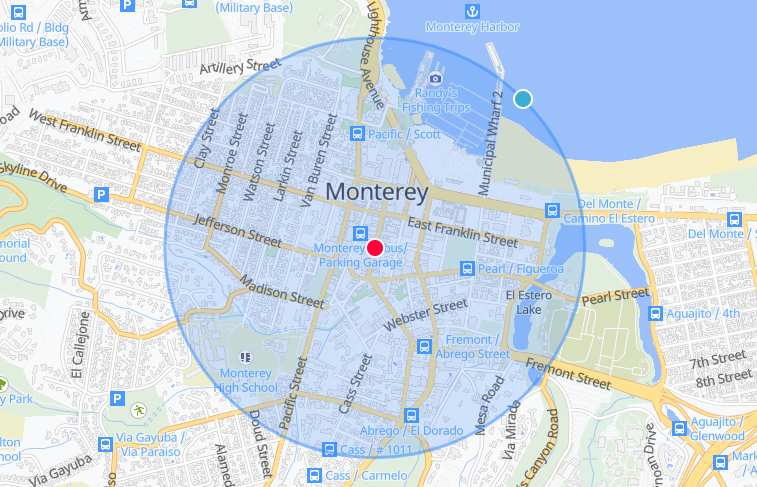
It may be hard to believe, but most of the Monterey Peninsula can be considered a Service Desert. Within a 0.5 mile radius from downtown Monterey, the only full-time service providers for homeless and housing-insecure residents are Gathering for Women and the Shuman Heart House. Other providers such as Al and Friends, I-Help, and various religious groups are usually only available on a part-time basis or a limited schedule; and highly utilized services like free or low-cost healthcare clinics and Monterey County Social Services are outside of this “walking distance” radius. This means a person experiencing homelessness in Monterey will have to put in significant time and effort just to meet their basic needs on a daily basis.
A mile (or 12) in her shoes
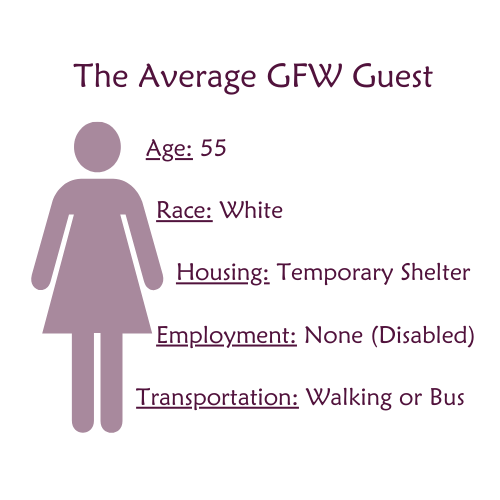
The average GFW guest (click here to read more) is 55 years old, white, non-Hispanic, living in a temporary shelter such as a friend’s couch, I-Help, or Casa de Noche Buena. She likely does not have a vehicle, and relies on public transportation or walking to get to the services she needs. In fact, only 40% of our guests have regular access to a vehicle, which dramatically affects the manner and frequency in which our guests can interact with and receive services.
Because GFW is a Day Center where guests can come and go as they please, there is a large difference between the average of our guests throughout the year and the average of guests who attend services regularly. In this post, the “average” is of the recurring guests, more closely resembling the modal guest. The word “average” is used as a shorthand for the general public and should not be taken to mean the mathematical average of all guests. Further questions about GFW’s demographics can be directed to Kelli Catey at kelli@gatheringforwomen.org.
Each morning our average guest wakes up at 5 AM to clean up her things and tidy up the area for whichever local church hosted the I-Help women’s program last night. By 6 AM, she is on the bus out and being dropped off around central Monterey for the day. From 6 AM to 8 AM, she is walking, carrying all of her possessions, to any location that is open and sheltered from the wind and marine layer during those early morning hours – usually a cafe or diner. At 8 AM, GFW opens, so she arrives at GFW to spend her day receiving meals, clothing, a shower, Case Management, Housing Navigation, and perhaps participate in an activity like Laughter Yoga or an art class. At 3 PM, GFW closes, giving her enough time to gather her things and walk back to the pick up location for I-Help, which can vary in time and location depending on the driver and the destination. Provided she needs no other services that day, she will walk an average of 2 miles.
However, there are very few days in which she will need no other services. As a result of regular Case Management and Housing Navigation, she will likely need to reach out to the Monterey County Department of Social Services, which is nearly 4 miles, one way from GFW, and a grueling 1.5 hour walk carrying all her possessions. If she has the money, she can take a bus from the Monterey transit center, but she must get there within the 10 minute window that two busses leave on this route or she will have to wait another hour for her next opportunity. While at the MCDSS, she will have to wait to be seen, with some guests waiting for multiple hours to be served. At this point it’s a race against the clock to see if she can be seen by MCDSS before she has to start walking back to the pick-up location for her overnight shelter. Most of our guests will forego receiving services in order to ensure a place to sleep at night, so this journey to MCDSS may take multiple tries before she’s able to access her services.
She will also need to do laundry at some point, and GFW does not currently offer laundry services. However, the Sabu Shake Sr. Good Samaritan Center in Sand City does, so she can go there to do her laundry for free. The “Good Sam Center” is an additional 25-minute walk from Monterey County Department of Social Services; and, unfortunately, the busses available will still only get about halfway there, leaving our guest to walk the final 13 minutes whether she rides the bus or not. The machines are also in high demand, so she will want to get there early to secure their use, meaning she might not have time to even come to GFW that morning. After her laundry is finished, she will need to start her journey back to her pick-up location for her overnight shelter, which is another 1.5-hour walk if she cannot take her laundry on the bus with her.
Living in temporary shelters, the accompanying stress, and walking for miles – often in footwear not suited to long walks – will all mean she is highly likely to need medical services at least once a year, if not more often. At 55, she does not yet qualify for Medicare, so she relies on the ER or avoids medical care altogether. She likely qualifies for Medi-Cal, but setting up that service requires an additional trip to MCDSS or to a healthcare provider, so she may or may not have access just yet. However, she needs to see someone for an immediate issue, and even if she has been approved for Medi-Cal, the only provider accepting new patients in Monterey is Doctors on Duty. She can get there by walking another 36 minutes or by taking the bus part of the way and walking a further 10 minutes. Similar to her MCDSS experience, she will have to wait to be seen for anywhere from 20 minutes to 5 hours. If she is there on a busy day or arrives too late, she may have to leave to secure a bed for the night before she is called in to see a doctor. This experience often leads to guests either arriving at the ER for preventable conditions or avoiding and refusing medical help altogether.
Since our guest is also attending Housing Navigation meetings regularly, she will also be going to meet with landlords, property managers, and other service providers GFW can connect her with. Without a car, this becomes an expensive and laborious process for her, and can result in additional time spent walking to and from opportunities or missing opportunities altogether. On average, the affordable rental properties our guests find are between 3 and 5 miles from our Day Center, which is anywhere from 1 to 2 hours of walking each way.
On top of this, our guest is likely to need additional items of clothing, personal care items, accessories, medications, or foods for specialty diets she cannot get at GFW. Given she has no car, she will need to find these items in a location that is easy to walk to and only purchase items that are light enough to carry. Depending on her needs, she may be able to access these items between a combination of Trader Joe’s, Walgreens, Troia’s, and some gas stations, but it is more likely she will want to go to a supermarket like Lucky’s, Target, or Safeway, the closest of which is 3 miles away, or just over an hour’s walk.
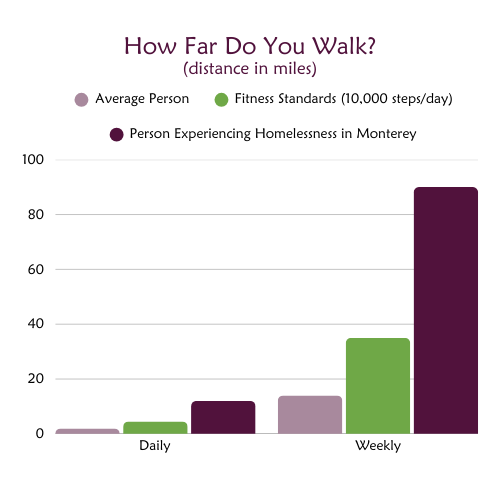
Altogether, for an average guest of GFW to access all the items she needs in a given week, without a car, she must either walk 90 miles, or spend $40 on bus fare and still walk 28 miles a week. This is almost 3x more than the oft-recommended “10,000 steps per day” and over 6x more than the average person. Even walking can cause adverse effects when done at such high levels – especially for individuals not accustomed to that level of exertion. At 55, carrying all the possessions she owns, and living on a fixed income of less than $400 a month (on average), walking over 12 miles a day is a daunting task, and sacrificing 40% or more of your income to walk 4 miles a day can often seem like an undesirable tradeoff. Adding the travel times and wait times compared to the times she needs to be finished in order to secure her bed for the night, our guest has time to do little else but survive.
Impacts on Employment
We are often asked if we are helping our guests find employment. While we have resources to help our guests who are able to work, the majority of our guests are unable to work full time schedules (52%) or at all due to a disability or lack of accommodations (26%). If we continue with our average guest, she is 55 and has not worked for many years due to disability. This leaves her in a difficult position of being able to work only if a job can accommodate her schedule (she still has to arrive at her pick up location for her nightly shelter before 5 PM) and her limited physical ability. There are not many jobs that allow a person to remain seated most of the day and end the work day at 4 PM. There are even fewer of those jobs that would hire 55-year-old woman with little to no work history. And even fewer that are available within walking distance. Thus, our guest must now decide between remaining unemployed; finding a job that she is physically unable to maintain leaving her at risk of adverse health conditions; or finding a job that will keep her past her shelter pick-up time, rendering her employed but unsheltered each night.
If our guest does receive a job offer, she still has a few more steps to take before she can become employed. All employees are required to provide their employer with necessary identification documents. Because our guest is unlikely to have a passport, she will be required to produce two forms of identification which can include her driver’s license, birth certificate, social security card, military ID, or a Native American tribal document among other things. Depending on the circumstances of her homelessness, it’s highly likely she is missing at least one of these documents. GFW assists multiple guests each year (approximately 17%) with re-attaining their Birth Certificate, Social Security Card, and Driver’s License. This process is a lengthy one and will likely take multiple trips to the relevant agencies in order to receive all necessary documents. It can take up to 8 weeks to just receive these documents and it is highly unlikely that a potential employer would be able to wait that long.
If a guest were able to obtain all necessary identification documents and find suitable employment, she would now be employed and increasing her income! However, her work schedule will now interfere with her case management and housing navigation appointments. Some agencies might be able to accommodate her after hours, but she will have to take time off from her new job in order to meet with additional service providers for housing programs. She now has to carefully manage her days of employment against her days spent finding housing or risk losing both. And in this process, assuming she’s found suitable employment within walking distance to the pick up and drop off location of her shelter, she is still walking a minimum of 4 miles a day.

Impacts on Physical Health
In light of these daily and weekly needs, proper healthcare is a must, and proper foot care is crucial to survival for most of our guests. If a guest sustains an injury or illness that renders her unable to walk long distances, she becomes significantly hindered in her ability to access services, obtain or maintain employment, and find housing. Unfortunately, proper foot care has been a recognized issue for people experiencing homelessness for a very long time.
The most prevalent foot issues found in people experiencing homelessness are frostbite, foot ulcers, peripheral arterial disease, foot infections, and related amputations. Any of these issues can render a guest unable to walk long distances, with the knock-on effects of perpetuating her homelessness. The most effective ways to support proper foot health among people experiencing homelessness are to provide regular screenings, access to foot exams, appropriate footwear, and education.
At GFW, we are consistently looking for ways to meet our guests’ needs. For foot care, our best community partner has been Clínica de Salud‘s mobile clinic that provides physical and dental exams and basic healthcare to our guests each month. Since beginning our partnership in 2024, Clínica de Salud has been able to serve over 40 guests on GFW’s premises and made additional referrals for guests with more intensive health needs. Our second best community partner has been the incredible residents of Monterey County. Through the donations to our Clothes Closet, we have been able to provide over 175 guests with new footwear in 2025 that is best suited to their needs. We are grateful and humbled by this continuing support and are dedicated to persevering in these efforts.
How can you help?
These circumstances that affect daily survival for our guests are difficult to overcome, but they are not insurmountable. You can help change these circumstances by supporting public transportation initiatives, free and low-cost public health clinics, and donating clean socks and athletic footwear to your local service providers. You can also be part of the larger solution to homelessness and support GFW’s efforts and our guests by:
- Supporting local efforts to build more affordable housing
- Supporting local homelessness prevention efforts like rental assistance and financial education programs
- Volunteering your time and talents to local homeless service providers
- Donating clothing or personal care items, or making a monetary contribution to your local homeless service providers
- Becoming an ambassador by telling everyone you know about your favorite non-profit and what we are doing to help!
If you are ready to be part of the solution, you can find ways to get involved at GFW on our website, or contact us at info@gatheringforwomen.org.
The Main Contributor for this post is:
Resources used in this post:
- United States Department of Agriculture – https://www.ers.usda.gov/amber-waves/2011/december/data-feature-mapping-food-deserts-in-the-u-s#:~:text=What%20Is%20a%20Food%20Desert,case%20of%20rural%20census%20tracts).
- Pressbooks Spatial Mapping – https://ubalt.pressbooks.pub/spatialanalysisenvironmentalstatisticsr/chapter/service-deserts/
- I-Help Monterey Bay – https://www.ihelpmontereybay.org/
- Casa de Noche Buena – https://gatheringforwomen.org/community-partners-and-resources/
- Monterey County Department of Social Services – https://www.countyofmonterey.gov/government/departments-i-z/social-services/dss-office-locations
- Sabu Shake, Sr. Good Samaritan Center – https://westernusa.salvationarmy.org/monterey_peninsula_corps/cure-hunger/
- Central California Alliance for Health – https://provider.portal.ccah-alliance.org/ProviderDirectory/PCP/Results?plan=Medi-Cal&lang=en
- Doctor’s on Duty – https://www.salinasvalleyhealth.com/locations/doctors-on-duty-monterey/
- Should You Walk 10,000 Steps Per Day for Weight Loss? – https://www.verywellfit.com/10000-steps-per-day-fitness-weight-loss-3435744
- How Many Miles Should I Walk in a Day? – https://www.verywellfit.com/how-far-can-a-healthy-person-walk-3975556
- 2024 Monterey County Homeless Census – https://chsp.org/wp-content/uploads/2025/03/2024-Monterey-County-Census-Release-Presentation.pdf
- U.S. Government Accountability Office (GAO) – https://www.gao.gov/products/gao-24-105435
- A Preliminary Assessment of Barriers and Facilitators to Accessing Foot Care in Homeless Shelters: A Scoping Review – https://www.sciencedirect.com/science/article/pii/S0890509624006976
- Clínica de Salud del Valle de Salinas – https://csvs.org/
- Gathering for Women – https://gatheringforwomen.org/
- Google Maps – https://www.google.com/maps